
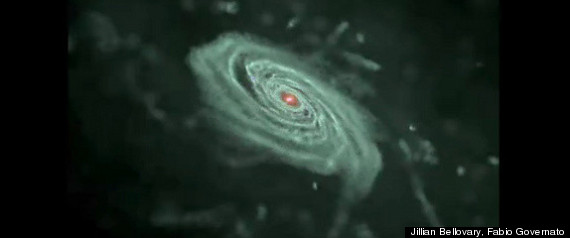
Black holes have long been cosmic mysteries, even as research in the past decade has shed some light on the largest of these dark objects and how matter pours into them.
Scientists say the many remaining puzzles include how the largest black holes were born at the dawn of the universe and how black holes may help shape the fate of galaxies.
"The whole field of 'massive black holes in galaxies' really developed in its own right in the last 12 years, and now it's one of the hottest in astronomy," Marta Volonteri, an astrophysicist at the Institute of Astrophysics in Paris, told SPACE.com. Volonteri is the author of a study on the evolution of the largest black holes appearing in the Aug. 3 issue of the journal Science.
Black holes have gravitational pulls so powerful, nothing can escape, not even light. Astronomers began mulling over the possibility of black holes in 1783, and scientists used Einstein's theory of general relativity to predict black holes in 1916.
Astronomers know of two "flavors" of black holes: "stellar-mass," which are up to a few dozen times the mass of Earth's sun, and "massive," which can be billions of times the sun's mass — nearly the mass of all the stars in the entire Milky Way galaxy. Stellar-mass black holes are known to be the remains of dead stars, but it remains a mystery how the far-more-massive black holes formed. [Photos: Black Holes of the Universe]


No comments:
Post a Comment